

Summary:
-
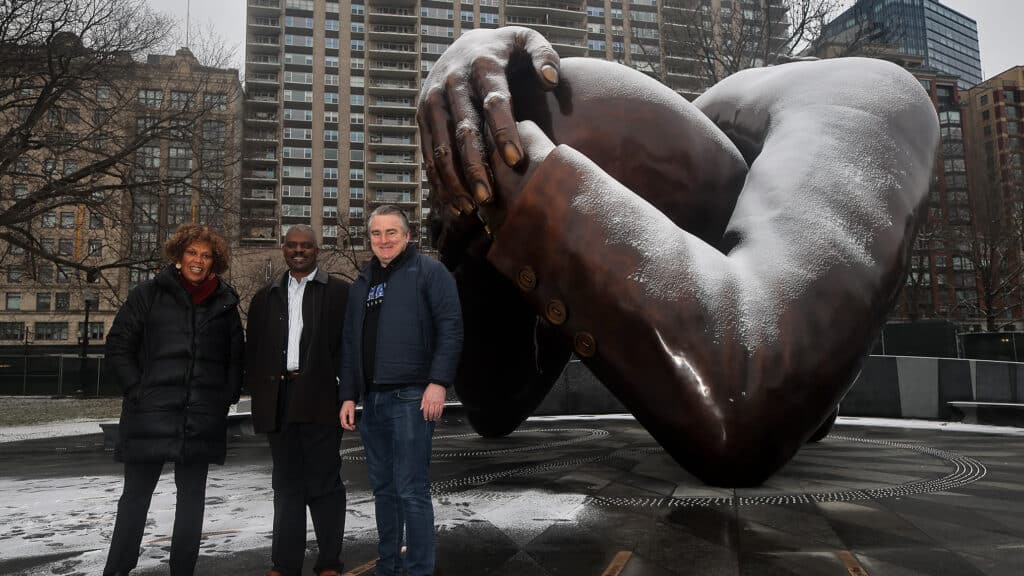
A statue honoring Martin Luther King Jr. and Coretta Scott King was unveiled in Boston before MLK Day.
-
The statue, called “The Embrace,” sparked debate over its location, design, and representation of Dr. King’s personal life.
-
Opinions on the statue and Dr. King’s legacy vary, highlighting the complexity of historical figures and their flaws.
A few days before Martin Luther King Jr. Day, a statue was unveiled in his honor in Boston, Massachusetts. The location of the memorial puzzled some, but as it turns out, Martin Luther King Jr. attended Boston University for his master’s degree, and his wife, who the statue is also dedicated to, attended the New England Conservatory. The statue, called “The Embrace”, was created by artist Hank Willis Thompson, and is based on a photograph taken of Coretta and Dr. King hugging after he won the Nobel Peace Prize in 1964.
Please read my other tweets about the sculpture—but here is another angle and the photo of the two “The Embrace” is based on. It’s when MLK Jr. found out he won the Nobel Peace Prize in 1964. pic.twitter.com/Q7Vyk7OPKK
— Amaka Ubaka (@AmakaUbakaTV) January 14, 2023
The King family was present for the dedication of the statue on January 13, which is located in the Boston Common, the oldest public park in the nation. Yolanda Renee King, the 14-year-old granddaughter of Martin Luther King Jr. and Coretta Scott King, spoke briefly at the event.
14-year-old Yolanda Renee King, granddaughter of MLK Jr and Coretta Scott King, speaks at unveiling of ‘The Embrace' memorial in Boston https://t.co/SHkvl8eNuI pic.twitter.com/SlzLKjgTTz
— philip lewis (@Phil_Lewis_) January 13, 2023
Today, the statue trends on Dr. King’s birthday, a national holiday. While some admire the statue’s intended message of enduring love amid the struggle for racial justice, others point out some marks the statue may have missed.
The first of these is the location of the statue–Boston has a history of racism and de facto segregation. This tends to be overlooked due to the city’s location in the northeast, and generally democratic leaning leaders over the course of the past few decades.
ADVERTISEMENT
The Boston Globe columnist Jeneè Osterheldt wrote that the statue was “a centering of Black love, and a monument that shows a gentleness America often denies Black people.” The statue is reportedly the largest monument dedicated to a civil rights leader in the United States.
Others felt that the statue’s design is what made the message get lost in translation. The statue is bronze, and thus leaves race an enigma visually. The Washington Post columnist Karen Attiah felt that the statue’s design, which only features the arms of the embrace, was insensitive to the long American history of violence against Black people. She detailed her thoughts about the statue’s shortcomings in a Twitter thread.
Public art and the decisions around it are political.
In a country that has VERY FEW public monuments and statues of Black people, the "Embrace" Martin Luther King statue in Boston sends a message.
A lot of the wrong ones. (1/n)
— Karen Attiah (@KarenAttiah) January 16, 2023
The sculpture also sparked discourse among artists and art critics on TikTok. Hank Willis Thomas’ hefty portfolio documenting the Black experience in America with a sharp attention to detail is what surprised people about the sculpture’s abstract nature.
@artlust Replying to @basilmaggi #Art #arthistory #arthistorytok #arthistorytiktok #arthistoryfacts #contemporaryart
Others feel that the statue, which references Dr. King’s personal relationship with his wife is in poor taste. The FBI attempted to destroy Dr. King’s reputation by wiretapping him, and they discovered that he had many extramarital affairs. The documents were sealed until 2019.
ADVERTISEMENT
Opinions on Dr. King have varied since its revelation–some feel that his personal life should be separated from his important contributions to the Black community in America. Others feel that this taints his legacy. School children in Boston are now being shown a documentary about Dr. King and Coretta Scott, and some take this as a whitewashed form of history.
@knowforsurepod EPISODE 8 OUT NOW @knowforsurepod ???? We swear you don’t want to miss this episode! (Any of them actually) Tune in NOW! Link in bio ???? #KnowForSurePod What makes a person a “good person” to YOU? I want to hear your answers in the comments!
Despite a wide variety of opinions on American history’s interpretation of Dr. King, and “the Embrace,” one thing is made clear–historical figures, regardless of their achievements for the greater good, are all flawed and human.