
Summary:
-
There’s a Danish word, hygge, describing intentional coziness and warmth in everyday spaces for comfort, connection, and contentment.
-
Hygge design emphasizes furniture that invites people in, with a focus on comfort, connection, and genuine warmth.
-
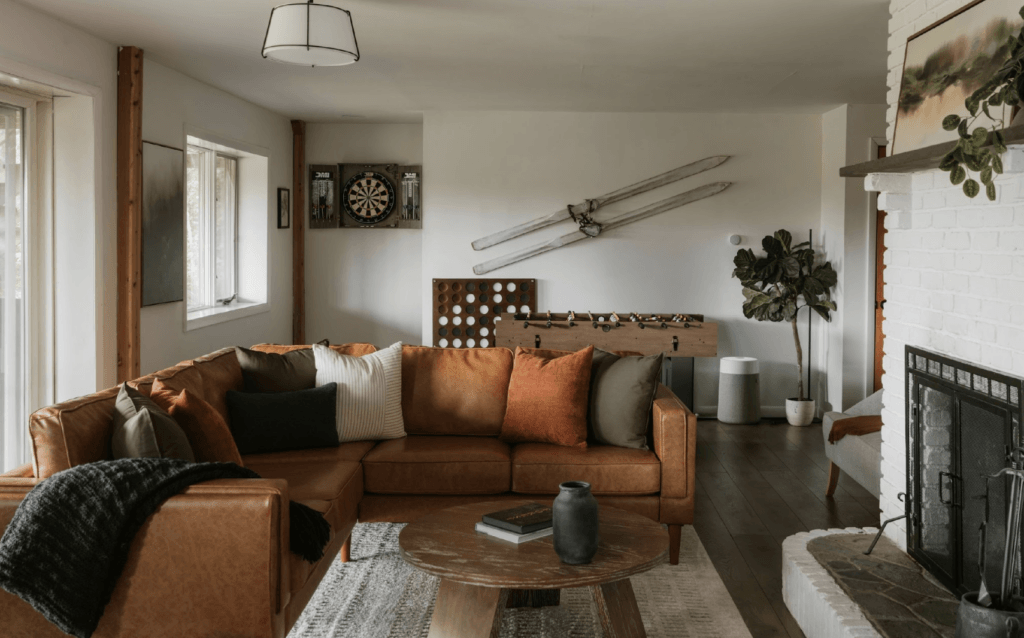
Full-grain leather sectionals in warm neutrals complement the hygge color palette, creating a cozy atmosphere with natural textures.
There’s a Danish word, hygge, pronounced hoo-gah, that has been circling the design world for several years without quite losing its resonance. The concept is simple enough – it describes a quality of atmosphere, an intentional coziness, a kind of deliberate warmth in everyday spaces and moments. The Danes, who contend with long, dark winters and still consistently rank among the happiest people in the world, treat it less as a decorating philosophy than as a way of organizing life around comfort, connection, and contentment.
In its essence, hygge is a philosophy that makes someone walk into your home and immediately get the “I love to live here” feeling — a feeling that can’t be manufactured by the right throw pillow or a well-placed candle alone. It requires the room’s anchor piece to earn it first.
Furniture That Invites You In
Hygge design is explicit about what furniture should do. A sofa with depth, a chair with a throw draped over it, a dining table that welcomes long conversations — upholstered pieces that feel better than rigid materials, in a room that feels lived in rather than staged. The goal is comfort that reads as genuine and intentional.
A sectional is the natural expression of this in a living room. Its scale and configuration do what a standard sofa cannot, creating a shared interior, a place where multiple people can settle in without negotiating for space, and where a single person can stretch across the full length without the room feeling oversized. The cozy, inviting sofa serves as the anchor of a hygge space, complemented by the kind of seating arrangements that encourage people to stay rather than perch — and the sectional pulls more people into that orbit than any other single piece of furniture.
What makes a cozy leather sectional particularly well-suited to this philosophy is the material itself. Full-grain leather carries a warmth that synthetic upholstery doesn’t — a visual richness that comes from the natural variation of the hide, the way it catches light differently across its surface, the way it develops character with use rather than looking newer the less it’s touched. Hygge explicitly resists the pristine and the staged. A home that’s too put together often feels cold — and full-grain leather, with its natural markings and the patina it develops over time, is the opposite of too put together.
Color and Texture as Atmosphere
The hygge color palette is neither accidental nor trend-driven. Hygge design draws on nature for its tones — calming creams, warm grays, deep browns — and chooses earth tones over bright accents, with the goal of creating a peaceful atmosphere where textures can stand out rather than compete. The emphasis on warm undertones is practical: colors with red or yellow undertones make even large rooms feel more intimate and cocooned, which is exactly what hygge spaces are trying to accomplish.
ADVERTISEMENT
Full-grain leather in a warm neutral — cognac tan, chocolate brown, saddle, or deep bourbon — maps directly onto this palette. These are tones drawn from the natural world: tanned hide, aged wood, worn leather goods that have been used and handled over years. They don’t compete with the room because they belong to the same vocabulary of warmth that the rest of the space is trying to establish. The neutral palette that hygge spaces rely on allows textures to really stand out — and leather’s texture, which shifts subtly between smooth and grainy across the surface of the hide, rewards the kind of close, unhurried attention that a cozy evening at home allows.
The layering that hygge interiors use to build atmosphere — throws across the arm of a sectional, cushions of different textures piled at either end, a wool rug underfoot — reads particularly well against a leather base.
The Room That Earns Its Atmosphere
Hygge interior design is about genuine warmth, not just visually but in the way the space functions. A room that looks cozy in photographs but feels stiff and carefully arranged in practice just mimicked the aesthetic without achieving it.
The distinction between a room that earns its atmosphere and one that approximates it lies in whether the furniture does its job. A cozy room needs a sectional that’s genuinely comfortable across an evening, not just inviting at first glance. It needs upholstery that softens and develops character rather than wearing out and looking tired. And it needs an anchor piece with enough visual weight to make the space feel settled and intentional — not like a collection of things that happened to be placed in the same room.
Hygge spaces are described as creating a sense of well-being and balance in everyday life, turning ordinary evenings into something that feels restorative and worth returning to. The living room that achieves that for the household using it is rarely the most decorated one. It’s the most considered one — where the choices made about what to put in the room were made in service of how it actually feels to be in it, night after night, through every season.
A leather sectional chosen with that intention — in a warm, natural tone, built from materials that develop rather than deteriorate, sized and shaped to hold the room and the people in it — is one of the most direct expressions of the hygge principle available in furniture form.
ADVERTISEMENT