

Summary:
-
President Trump expressed concerns about Netflix’s acquisition of Warner Bros. Discovery, citing potential market power issues.
-
The $72 billion deal would give Netflix access to Warner’s century-deep archive, creating a massive global streaming empire.
-
Trump broke presidential norms by indicating personal involvement in the approval process, sparking political and industry backlash.
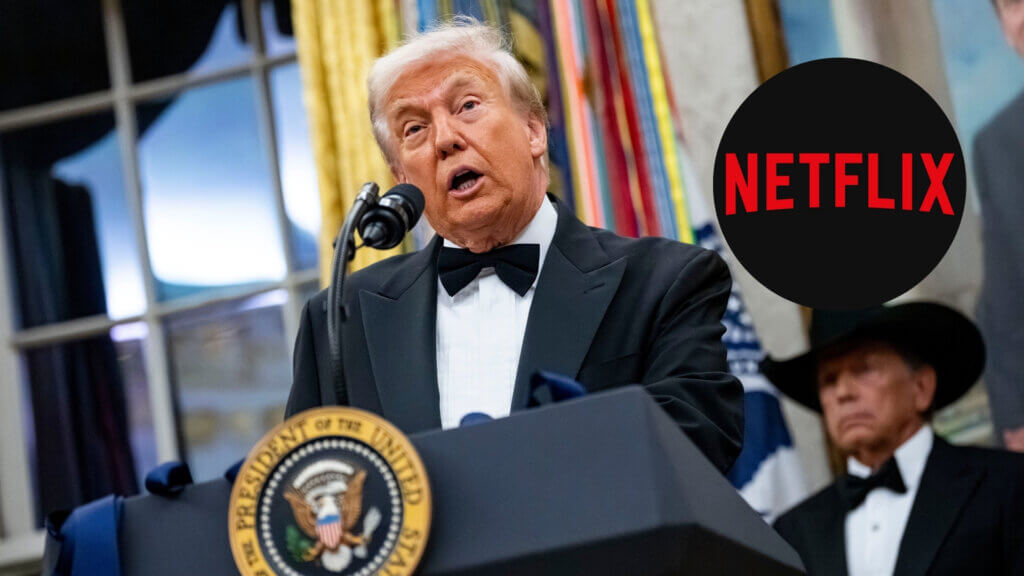
President Donald Trump signaled Sunday that Netflix’s proposed takeover of Warner Bros. Discovery might hit turbulence, telling reporters the massive merger “could be a problem” because of the market power the combined streaming giant would hold.
“Well, that’s got to go through a process, and we’ll see what happens,” Trump said while walking the red carpet at the Kennedy Center Honors in Washington. “They have a very big market share. When they have Warner Bros., that share goes up a lot.”
The $72 billion deal, which climbs to more than $82 billion with debt included, would fold Warner Bros.’ film studio, HBO, and HBO Max into Netflix’s empire of more than 300 million subscribers. The acquisition would give Netflix access to Warner’s century-deep archive, from The Dark Knight to The Sopranos, while excluding cable networks like CNN and TNT.
The merger announcement on Friday landed like a tectonic jolt across the entertainment world: Netflix, long the disruptor, suddenly wants to become Hollywood’s oldest institution. Warner Bros. Discovery’s studio and HBO library represent the kind of legacy catalog Netflix has spent years licensing around. Owning it outright would redraw the map for the global streaming wars.
Today, Netflix announced our acquisition of Warner Bros. Together, we’ll define the next century of storytelling, creating an extraordinary entertainment offering for audiences everywhere. https://t.co/rXPFMNIs1A pic.twitter.com/0pdsMUEob8
— Netflix (@netflix) December 5, 2025
Industry analysts have already noted the argument Netflix is expected to make. Since YouTube still commands the most streaming minutes from U.S. consumers, Netflix may claim it isn’t the monolith regulators once feared. But politically, the timing is far from simple.
ADVERTISEMENT
In comments that break with longtime presidential norms around antitrust cases, Trump signaled he personally expects a role in the approval process.
“I’ll be involved in that decision, too,” he said, adding he intends to consult “some economists” before determining the deal’s fate.
Historically, presidents have allowed the Justice Department’s antitrust division to independently evaluate major mergers. But Trump’s remarks come after two terms in which he has repeatedly shaped how corporate America approaches Washington, including media and tech consolidation.
The merger would not require Federal Communications Commission approval because neither company owns broadcast stations. It would need Justice Department clearance and reviews from international regulators such as the European Commission.
Earlier Sunday, Bloomberg reported that Netflix co-CEO Ted Sarandos visited the White House in mid-November to discuss the pending merger. Sarandos reportedly left with the impression Netflix would not face immediate opposition.
On Sunday, Trump confirmed the meeting. “I met with Ted. I think he’s fantastic,” he told reporters. “He was in the Oval Office last week.” Trump said Sarandos made no promises in the meeting.
ADVERTISEMENT
Trump compared Netflix’s dominance to the historical clout of MGM, which Amazon acquired during the Biden administration without opposition. His administration earlier approved Paramount Global’s merger with Skydance, but only after a contentious process that included unusual concessions. Paramount agreed to pay $16 million to Trump’s future presidential library over a CBS News interview with former Vice President Kamala Harris, which Trump alleged was deceptively edited. The company also agreed with Trump’s FCC to end its DEI programs and establish an ombudsman at CBS News.
The Netflix–Warner deal is already generating political backlash beyond the White House. Sen. Elizabeth Warren, a longtime critic of corporate consolidation, called the proposal an “anti-monopoly nightmare.”
If approved, Netflix would instantly become the most vertically integrated entertainment company on the planet, controlling production, prestige TV, blockbuster franchises, and the world’s largest streaming platform.
If rejected, it would be one of the most consequential regulatory decisions in modern media—one with global implications for how far any tech-entertainment merger can go.